What Do Battery Powered Generators Look Like?
One great advantage of battery generators is that they can be installed indoors, unlike fuel generators which must be placed outside or on the roof.
- Standalone units can be installed in the same room as the devices they power.
- Mobile units are like large, movable battery packs; you can roll them to wherever they’re needed most in your facility.
- Hardwired units are typically located near the electrical panel, although that’s not your only option. You can locate them elsewhere inside the building.
If you plan to install a battery generator in an area where people work or patients are present, its appearance matters. In some cases, it may be preferable to tuck it into a spare closet so it doesn’t look cluttered or out of place.
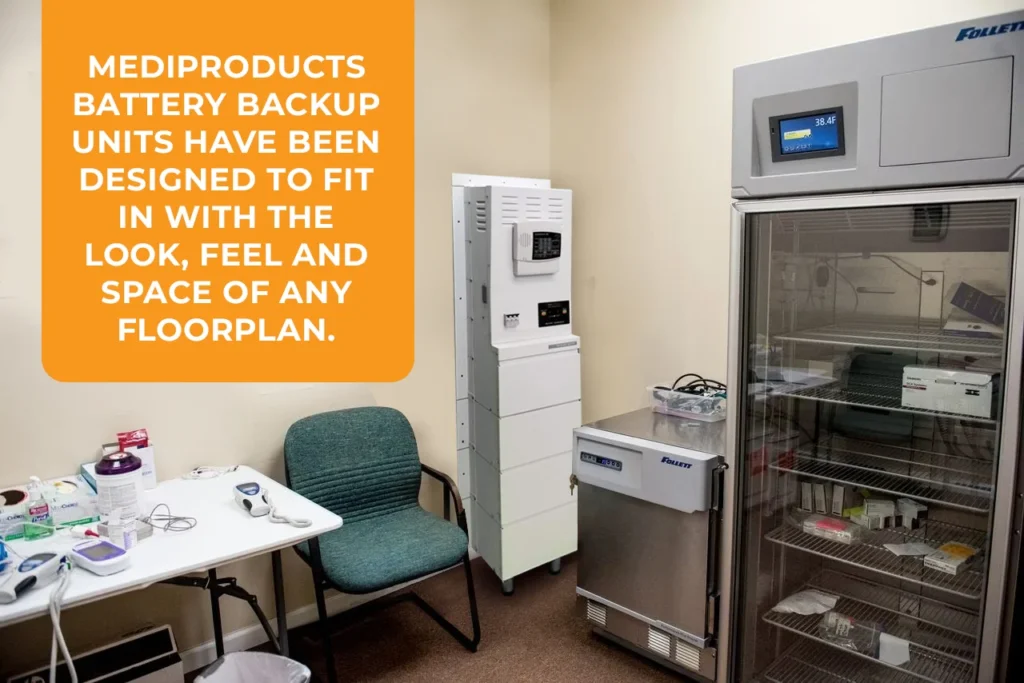
At EverSafe, our design goal for our hardwired and standalone systems (which we call the “Silent Sentry”) is to keep them quiet and unobtrusive until they’re needed during a power outage — blending into their surroundings. But blending in doesn’t mean compromising strength: we build them with robust materials. The hardwired and standalone systems come in an off-white metal finish, while mobile units sport a polished stainless-steel casing.
Our systems are made to save floor space. They are tall and narrow so more battery storage can be achieved without requiring more floor area.
- For standalone and hardwired units: about 18 inches long and 9.75 inches wide. Depending on power capacity, height can vary from 16 inches up to 93 inches. They weigh between 160 and 800 pounds.
- Mobile units are a bit larger: approximately 28.25 inches long, 16.5 inches wide, and height ranging from 17.75 to 42.25 inches. Their weight ranges from 155 to 765 pounds.
Because of this “upward rather than outward” design, only the height and weight change depending on how many batteries you need.
How Does a Standalone / Hardwired Silent Sentry Battery Backup Generator Look?
Standalone and Hardwired systems are enclosed in metal cabinets with a powder-coated off-white finish. Professional, understated, yet modern — they can be placed discreetly within your facility.
Every standalone or hardwired cabinet ships disassembled into three main components:
- Main Cabinet
- Battery Cabinets
- The Batteries themselves
The battery cabinets are stacked vertically and attach to the main cabinet (and to each other). These house the battery modules for emergency backup power. The lowest battery cabinet includes holes for feet to support the system; the feet may be removed later if needed.
The exterior of both the main cabinet and battery cabinets include 2-inch flanges used for mounting the system.
Main Cabinet Features
- Houses the inverter, which converts stored battery energy to power for your devices.
- Front and side panels have vents (slots) to allow air circulation for cooling.
- On both sides of the standalone/hardwired units there are four three-prong AC power outlets. Custom outlet configurations are available on request.
- The control panel is positioned in the lower right corner on the front face. It has a power switch (on/off), LED indicators for charge state and operation, and warning lights for conditions like overload, overheating, or low battery.
- The battery cabinet beneath the main cabinet includes the cabling to connect to the inverter, and comes with all required hardware, battery cables, and an input power cable, plus installation instructions.
Input/Output Power for Standalone Systems
- The input power port is situated on the left side of the main cabinet, under the AC outlets. It uses a standard 15-amp male connector.
Input/Output Power for Hardwired Systems
- Hardwired units include built-in circuit breakers (UL-489 rating) located at the bottom left of the front. This allows the unit to serve as a small circuit panel or subpanel.
- There are six small knockout holes on both sides at the top front for connecting to your building’s electrical panel.
- The input power connections are located inside the main cabinet. Installation must be handled by a licensed electrician.
How Does a Mobile EverSafe Battery Backup System Look?
Mobile systems arrive fully assembled, in sleek stainless steel casing, with black locking casters on the base. We build them with materials suitable for sterile or clean environments (e.g. operating theaters, laboratories).
Depending on required storage capacity, mobile units may have one, two, or three tiers of cabinets. All essential components are housed in the topmost cabinet.
- The top cabinet also offers a clear, functional counter surface for added utility.
- On the front face of the top cabinet are 4 pairs of AC outlets (i.e. 8 outlets per top cabinet).
- The input power port (standard 15-amp male connector) is found on the right side of the top cabinet.
- A control panel (same kind as on standalone/hardwired units) is located beneath the outlets. It includes an on/off switch, LED indicators for charge and status, plus warning LEDs for overloads, overheating, or low battery.
- The mobile unit sits on four black locking casters so you can move it as needed.
How Does a Power Outage Alert System Look?
The EverSafe Power Outage Alert system is designed to notify up to four different phone numbers when your facility loses power and backup power becomes active.
- It has a compact, square form factor, with off-white/gray coloring. Measures about 7.8 × 8.8 × 2.1 inches.
- When integrated with a battery backup system, it mounts neatly onto the front of the topmost cabinet, matching the system’s styling.
- The front panel features controls and an alphanumeric keypad for entering phone numbers to receive alerts. LED indicators show system power, battery status, alarms, and phone line status.
- The top right corner of the alert unit houses input ports for power and for phone lines.
Get Help Finding Out What System Best Suits Your Needs
Every system is tailored to match each customer’s requirements, both in power needs and physical form factor. The fastest way to get a system that fits you is to contact EverSafe’s product experts. They can help with quotes, including alarm systems if needed.