El Niño does not create a single, uniform weather threat. It changes large-scale atmospheric patterns, influencing where storms develop, how precipitation is distributed, and which regions experience unusual seasonal conditions. For industrial facilities, that uncertainty makes preparation more complex than planning for one expected storm.
The question is not simply whether El Niño will cause an outage at a particular site. It is whether existing continuity plans account for a season in which familiar assumptions about weather, utility reliability, site access, and restoration time may no longer hold.
The NOAA Climate Prediction Center reported in August 2026 that El Niño was strengthening, with a greater than 90% chance of becoming a very strong event during fall and winter 2026–27. Although a strong El Niño increases the likelihood of characteristic seasonal effects, NOAA emphasizes that specific local impacts are not guaranteed.
That distinction matters. Industrial preparedness should be based on operational vulnerabilities, not a single weather forecast.
Look Beyond the Initial Power Failure
Severe weather planning often focuses on the moment utility power is lost. For an industrial operation, the effects can begin earlier and continue much longer.
Voltage fluctuations may affect sensitive controls before a complete outage occurs. Heavy precipitation can limit access to the property, delay utility crews, or prevent maintenance personnel from reaching the site. Flooding can damage substations and electrical equipment. Supply interruptions may extend downtime even after electricity has been restored.
A facility may also experience repeated short interruptions rather than one prolonged blackout. These events can be especially disruptive to programmable logic controllers, network switches, security systems, process controls, and automated machinery. Every restart introduces another opportunity for lost settings, corrupted data, equipment faults, or an incomplete production cycle.
El Niño planning should therefore address power quality, transition time, and restart behavior in addition to total outage duration.
Identify the Loads That Control the Consequences
Providing backup power to an entire industrial facility may be impractical. A more useful approach is to identify the smaller group of systems that determine whether an interruption remains manageable.
These loads may include control panels, industrial computers, network infrastructure, communication systems, access control, pumps, alarms, ventilation, emergency lighting, or equipment needed for a controlled shutdown. Their electrical demand may be modest compared with production machinery, but their operational importance can be much greater.
For example, maintaining power to a controller may allow equipment to preserve process data and stop in the correct sequence. Keeping communications online can help managers coordinate staff and confirm site conditions. Supporting a pump or ventilation system may prevent a power interruption from developing into an environmental or safety incident.
The most important backup load is not always the largest one. It is often the system that prevents the outage from causing a second problem.
Reconsider How Long “Temporary” Means
Many continuity plans assume that a generator will start quickly, staff will be available, and utility service will return within a familiar timeframe. A disruptive weather pattern can challenge all three assumptions.
Generator startup does not eliminate the transition gap between utility failure and emergency generation. Fuel delivery may become more difficult when roads are flooded or regional demand is elevated. Severe weather can also extend restoration times, particularly when damage affects multiple communities.
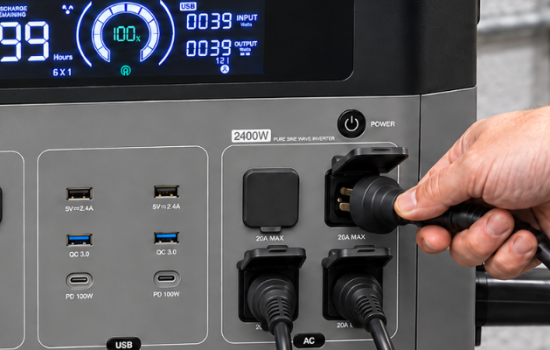
Battery backup systems can provide immediate, automatic power during this gap. For selected loads, they can bridge the transition to generator power, support an orderly shutdown, or maintain operation for a defined runtime. They can also respond to voltage disturbances that may not trigger a conventional generator.
Runtime should be based on a realistic operating strategy. Facilities should determine whether equipment must remain online for several minutes, several hours, or through an unattended overnight period. The answer should reflect local hazards, staffing, generator availability, and the consequences of losing each load.
Test the Facility as a Connected System
A continuity plan can appear complete on paper while still failing at the points where systems interact. Before seasonal weather intensifies, facilities should test transfer behavior, battery condition, alarms, communications, and shutdown procedures under realistic conditions.
Testing should also confirm that recent operational changes have not made the plan obsolete. Added equipment, new control systems, expanded network infrastructure, or longer production schedules may have changed the facility’s electrical requirements.
El Niño preparation is ultimately an exercise in challenging assumptions. Weather outcomes will vary by region, but industrial facilities do not need a precise local forecast to identify critical loads, review recovery dependencies, and strengthen weak points.
EverSafe Power designs battery backup systems for industrial, commercial, and mission-critical applications. By matching backup capacity and runtime to the systems that control operational consequences, facilities can prepare for an unpredictable season without trying to predict every individual storm.