Can Battery Generators Deliver Adequate Power for Healthcare Facilities?
Earning and maintaining accreditation is critical for any healthcare institution. Accreditation, coupled with dependable backup power, ensures the facility can continue operating and serving its patients. Without these measures in place, the facility may be forced to shut down.
According to the American Association for Accreditation of Ambulatory Surgery Facilities (AAAASF)—a prominent accrediting authority—facilities seeking accreditation must be equipped with the necessary instruments to perform all procedures listed in their application and must be prepared to manage emergencies.
Among medical specialties and accrediting agencies, the exact backup power requirements can differ significantly depending on factors such as the clinical field, geographic location, and whether the facility participates in Medicare or Medicaid programs.
Why Backup Power Is Essential in Outpatient Surgery
The amount of gear, the variety of machinery, and how the facility operates directly influence the size and capacity of the needed backup power solution. For office-based surgery facilities, the general recommendation is to have a minimum of 2 hours of Type 3 Essential Electrical System (EES) backup power. This duration aligns with the requirements of most accrediting bodies and guarantees sufficient time to safely complete procedures or stabilize patients until normal power is restored.
A widespread misunderstanding is that battery-backed backup systems are prohibitively expensive for surgery centers, as their size would need to be exceedingly large. However, because most devices are not running continuously during those two hours, the actual power demand is far less substantial than one might assume—making battery backup a more cost-effective solution than commonly believed.
What Facilities Can Rely on Battery-Powered Generators?
Below is a summary from the product brochure showcasing a typical office-based surgery environment. It highlights individual power requirements for equipment and offers a realistic estimate of total power needed to operate safely for 2 hours. Rather than assuming all devices run nonstop for the full duration, this estimate reflects how each component is commonly used, giving a more practical projection that aligns with real-world surgical settings.
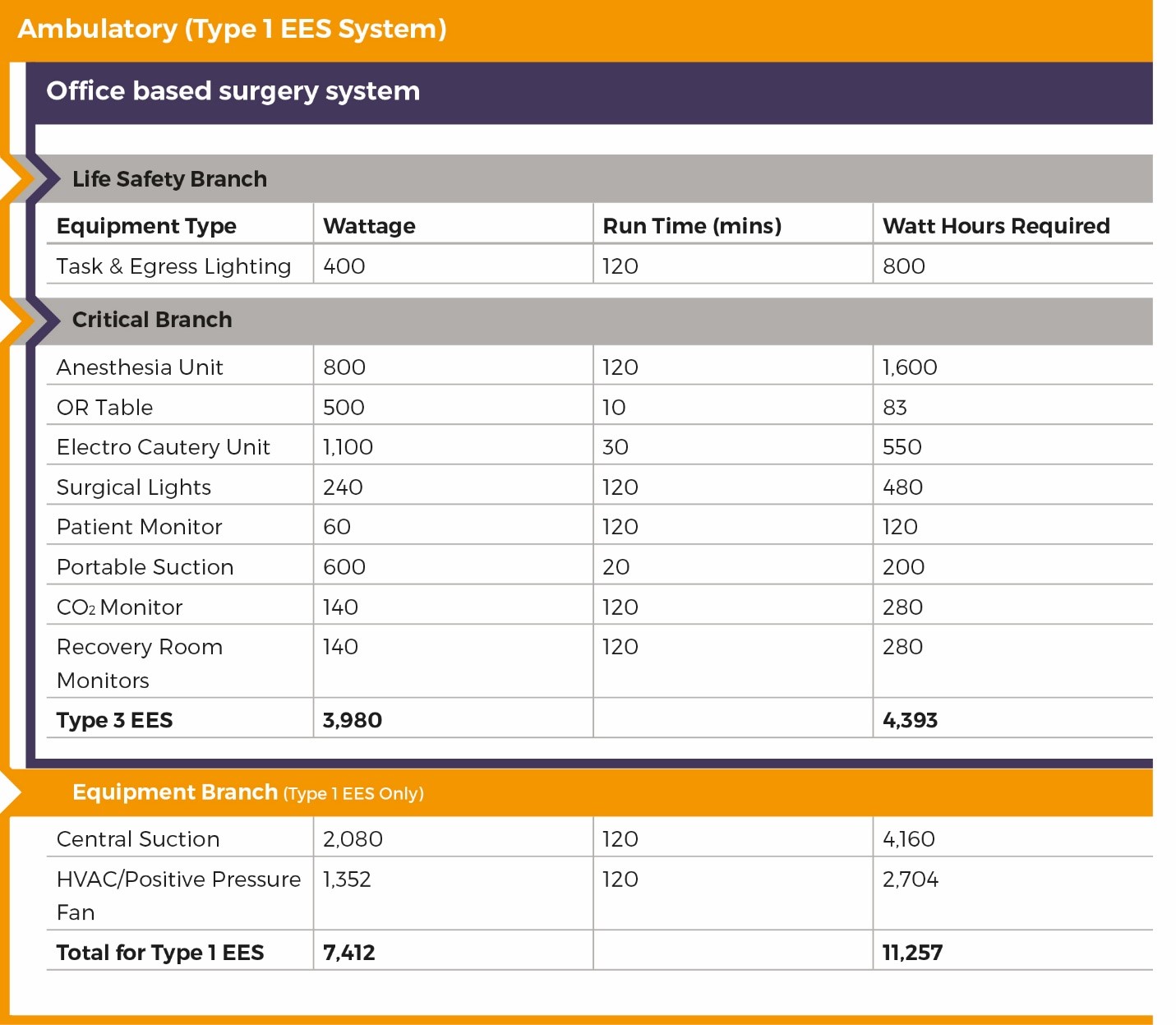
This method assists facilities in meeting compliance efficiently without unnecessary cost overestimation.
Among the highest power-consuming items—such as the operating table (500 W), cautery unit (1,100 W), and portable suction system (600 W)—none run continuously, and they account for only about 20 % of total usage.
Meanwhile, tools like lighting and monitors—including those used throughout procedures—consume far less power thanks to modern, efficient designs. Together, they make up just under 50 % of the total energy used. As technology improves, these efficiencies can further extend your effective backup runtime.
Since each facility is unique and standards may vary by accrediting body, it’s highly advisable to review your specific accreditation guidelines and work with an EverSafe expert to identify the most appropriate backup power solution for your needs.