NSF456…IS YOUR FACILITY COMPLIANT?
The NSF456 vaccine storage standard was developed collaboratively by the Centers for Disease Control and Prevention (CDC) and NSF International (formerly the National Sanitation Foundation), with input from vaccine producers and refrigeration manufacturers. The goal was to create a consistent performance standard for vaccine refrigerators, freezers, and combination units. It ensures strict temperature control from manufacturing through to administration, maintaining the cold chain.
The CDC defines the cold chain as “a temperature-controlled supply chain that includes all vaccine-related equipment and procedures… beginning with the storage unit at the manufacturing plant, extending through transport and delivery, and ending with vaccine administration.”
In 2021 alone, over 11.2 billion doses of COVID-19 vaccines were produced. With numbers like these, preventing vaccine loss due to poor storage is critical.
According to the CDC, the key to maintaining the cold chain lies in three things: properly trained staff, reliable storage and monitoring equipment, and accurate inventory tracking. Yet, the World Health Organization reports that over half of all distributed vaccines are wasted each year—often due to expiration or exposure to improper temperatures.
What Does Vaccine Storage Standard NSF456 Mean for You?
Although NSF456 is not a mandated regulation, it is supported by both the CDC and NSF International. It expands on the CDC’s Vaccine Storage and Handling Toolkit, offering measurable performance benchmarks that help prevent vaccine spoilage and ensure consistency.
Healthcare providers don’t need to replace their current units to meet NSF456 guidelines. However, new purchases that follow the NSF456 standard will offer improved reliability and reduce the risk of costly vaccine loss. This standard applies to a wide range of vaccines, including refrigerated types like Hepatitis A, Hepatitis B, and HPV, as well as frozen ones like MMRV and some COVID-19 vaccines.
What Are the Requirements Detailed in Vaccine Storage Standard NSF456?
NSF456 employs a more realistic testing method than traditional temperature probes by using a Vaccine Simulation Device (VSD). This tool simulates real vaccine conditions and evaluates unit performance under “worst-case” scenarios.
According to Intertek, the standard requires the following:
- Refrigerators
• During door-opening tests, the temperature probe must remain between 2 °C (35.6 °F) and 8 °C (46.4 °F).
• Once the door is closed, the unit must return to 5 °C (41 °F) ± 3 °C within three minutes. - Freezers
• During door-opening, the probe must stay between –50 °C (–58 °F) and –15 °C (5 °F).
• The unit must recover to below –15 °C (5 °F) within three minutes after the door is closed. - Sample Testing
A minimum of one unit per model must be tested. Units in the same model family may be grouped for testing, as determined by engineering.
Where Can You Buy NSF456‑Compliant Refrigerators or Freezers?
Some manufacturers involved in the development of NSF456—such as American BioTech Supply—have models available that are tested and certified to meet the standard.
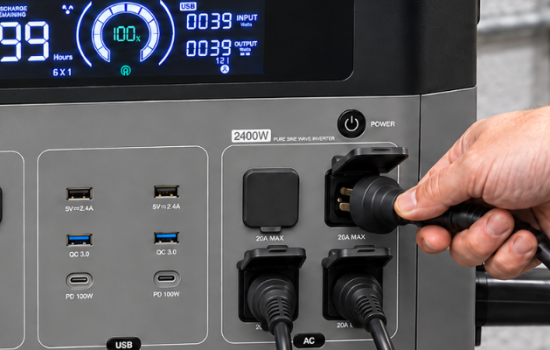
For added protection against power outages, you can also pair your refrigeration unit with an EverSafe battery backup system, which will help ensure your vaccine supply remains stable and secure during any interruption.
Learn More About Battery Backup Power
To answer even more of your questions and find additional solutions to problems that could affect your medical facility or laboratory, check out these other articles from the EverSafe blog and the EverSafe Learning Center:
Sources
- Vaccine Storage and Handling Toolkit, US Center for Disease Control and Prevention, Atlanta, GA, 2021.
- “11 Billion COVID-19 Vaccines Produced in 2021 Has Resulted in the Biggest Immunization Campaign in Human History and 2022 Will Require More and Better Vaccine Redistribution and Innovation.” IFPMA, International Federation of Pharmaceutical Manufacturers & Associations, 16 Dec. 2021, https://www.ifpma.org/resource-centre/11-billion-covid-19-vaccines-produced-in-2021-has-resulted-in-the-biggest-immunization-campaign-in-human-history-and-2022-will-require-more-and-better-vaccine-redistribution-and-innovation/#:~:text=Allow-,11%20billion%20COVID%2D19%20vaccines%20produced%20in%202021%20has%20resulted,better%20vaccine%20redistribution%20and%20innovation.
- Intertek. “NSF 456 Vaccine Storage Testing.” NSF 456 Vaccine Storage Testing, Intertek Group PLC, 13 Jan. 2022, https://www.intertek.com/appliances/vaccine-storage-testing/“.
- Monitoring vaccine wastage at country level (2005), World Health Organization, WHO/V&B/03.18. Rev.1, http://apps.who.int/iris/bitstream/handle/10665/68463/WHO_VB_03.18.Rev.1_eng.pdf?sequence=1&isAllowed=y.